S1 E11: Tech Talk: Effusion Analysis (Part 2)
S1 E11: Tech Talk: Effusion Analysis (Part 2)
Jessica is back with Part 2 of her ever-so-useful Tech Talk on Effusion Analysis, offering further tips and tricks to getting the most diagnostic information from your in-house fluid samples.
View Transcript
Welcome to Tails from the Lab, where an ever optimistic veterinarian and slightly salty technician entertain listeners with true stories and tall tales revolving around laboratory diagnostics.
Names have been changed to protect the innocent, but the lab work is real.
You can listen on your lunch break, on your commute, or when you’re hiding from your kids in the bathroom.
Each episode, we hope to leave you a little smarter, a little brighter, and feeling more empowered in the lab.
Hello, and welcome back to Tales from the Lab. I am Jessica, and I’m going to bring you another tech talk. Today’s tech talk topic is going to be the fluid analysis part two.
So we are going to touch base on the microscopic analysis. We’re going to talk about how to get that estimated nucleated cell count.
Talk about 100 cell count differential, what that looks like for fluid. And then at the end, I’m going to give you kind of our little nuggets of goodness that are biochemical testing on fluid that can help your clinicians with their diagnosis of what type of fluid they are seeing in their patients.
So let’s get started.
So let’s first talk about the estimated nucleated cell count.
So in part one, we talked about using our hematology analyzers to get that total WBC count and utilizing that as our total nucleated cell count. And those total nucleated cell counts, or TNCC as you’ll sometimes see them abbreviated, are super important for helping us with our fluid classifications.
So we need total protein,
a nucleated cell count, and then what cell types are there so that we can put our fluid into kind of the buckets for fluid classification, Transudate, modified transudate and exudate.
And so if we are not going to use our hematology analyzer to get that to total nucleated cell count, we need to use the, that direct slide that we made, the one that looks kind of like a blood film, to obtain our nucleated cell count.
So what we’re going to do, we made our slide and now we’re going to stain it routinely with diffquick and we are going to let it dry before we take a look at it.
And then we’re going to bring it over to our microscope and we are going to want to count the, the average number of cells over 10 fields. So we’re going to count cells in one field, you know, 1, 2, 3, 4, 5, 6 nucleated cells.
Then we move to the second field. We count those, we do that across 10 fields, total that number up and divided by 10 to get the average. And that average is important because we’re going to utilize it in our equation for our estimated nucleated cell count.
So that equation is the average nucleated cells per field. So we got that by counting over 10 fields and taking the average times our objective squared. So what do I mean by that?
Well, if you’re at a 40x, so that’s what our objective is. We’re going to do 40 squared. If you’re at 100x, we’re going to do 100 squared. If you’re at 50, we’re going to do 50 squared.
And that is going to give us our total nucleated cell count per microliter. And that’s the number that we’re going to use to help with that fluid classification.
So what do the cells look like in a fluid sample?
There are some kind of exceptions that we don’t see in a peripheral blood film. But as a general rule, we’re going to be counting the same cells.
Things like neutrophils, lymphocytes, e. Eosinophils, basophils. And I’ve left out monocyte, because in fluid we call them large mononuclear cells. This includes both the monocyte or macrophages as they are in fluid, because that’s what their job is, to go to, you know, wherever they’re needed and kind of start munching up whatever there.
And then also those large mononuclear cells include mesothelial cells. And so mesothelial cells line our body cavities. As we have chronicity with our fluid, those mesothelial cells will start to kind of exfoliate and fall off into our fluid and they can look really, absolutely bananas.
And we’ll have some images of mesothelial cells up on Instagram, but they can have a lot of blebbing to them. They can really look super scary.
But like I said, the. The kind of characteristic of them is they kind of have these fringes and these blebs on them.
We can also see other things in our fluid, things like mast cells. We have a whole classification called others,
and these are oftentimes neoplastic cells. You can use your standard cell counter, you know, that you kind of sit beside you and they have buttons on them and each button is a different cell.
And then count to 100 cells. Or there are all sorts of apps that you can also download, some of them are free that allow you to just utilize your phone as Your cel encounter.
So let’s talk about that biochemical testing on fluids.
So not everybody is lucky enough to have a clinical pathologist that works at their hospital or you may need an answer, you know, immediately, because these patients are oftentimes very sick.
And so we can take that bonus tube, that white top tube that we talked about in part one, and actually run some chemistry tests on them to help us confirm what type of process we have going on in fluid.
So the reason why we use the white top is because there’s no additives. So EDTA has, our EDTA tubes have EDTA in them. And just like we don’t run chemistry testing on our purple tops, we don’t run chemistry testing on our purple tops if they have fluid in them either.
So we want to use that non additive tube. So there are a couple of different types of fluid that we can, you know, maybe better diagnose by having these biochemical testings.
Bioperitonitis is one of them. So if we have, you know, something going on with our gallbladder, either it’s ruptured or maybe we have a gallbladder mucocele, we can actually use total bilirubin on our fusion to confirm that it is bile peritonitis.
And so this is a true emergency. This is something that needs to be taken care of. And so when we compare our total bilirubin in our fluid to that of our serum or plasma, we find that the T billy in the fluid is going to be elevated.
Septic peritonitis, also another critical emergency that we need to address.
We can both look at the blood glucose and also the lactate. So we’ll focus on glucose first. So we’re going to compare the peripheral blood glucose to the glucose in the abdominal fluid.
In septic cases, our blood glucose will be lower in the abdominal fluid due to bacteria utilizing the glucose that’s there and a difference of greater than 20 milligrams per deciliter.
In our septic cases that have bacteria in, you know, our fluid, we’re going to find that the bacteria is utilizing that glucose.
Kind of a caution is to not use handheld glucometers for this measurement just because of the amount of variability that we see in them. And we also want to try to make sure that those measurements are kind of happening at the same time.
So we want to try to get a fresh glucose from our peripheral blood and from our fluid sample.
We can also compare peripheral lactate and the abdominal lactate. The so in septic cases, our fluid is going to have a higher level than that of our peripheral lactate. Greater than 2 micromol per liter difference in lactate fluid, lactate will be higher.
So this is different than the glucose uroabdomens. Also another emergency.
So we can measure the creatinine and the potassium in our fluid. And so our fluid, when compared to that of our serum and plasma levels, will have a higher level of creatinine and potassium.
And a two times difference or greater than two times difference is considered diagnostic for a uroabdomen. The last one is a chylous effusion. So this is particular for cats too, because sometimes it can be tricky to determine if it’s a chylous effusion.
So we want to measure triglyceride and cholesterol in our fluid and compare that to our peripheral blood.
And so our triglycerides will be higher in our fluids, our cholesterol will be lower in the fluids. So try high, cold, low.
So those are kind of our tips for biochemical analysis. And I think the important thing to remember is that we’re comparing what’s in the fluid to what’s in our peripheral blood.
So that’s a key component. So if you don’t have a T Billy on your blood, you can’t use this as a confirmative method, just like if you don’t have a blood glucose or a lactate.
So you need to have that peripheral blood component before you can utilize these biochemical testing in the fluid. And that kind of completes our tech talks on fluids.
Tales from the Lab is a production of Antech Diagnostics. The intent of this podcast is to provide education and guidance with the understanding that any diagnostic testing and treatment decisions are ultimately at the discretion of the attending veterinarian within the established veterinarian patient client relationship.
Disclaimer: This podcast intends to provide education and guidance with the understanding that any diagnostic testing and treatment decisions are ultimately at the discretion of the attending veterinarian within the established veterinarian-patient-client relationship.

Holly Brown, DVM, PhD, DACVP
Holly is a veterinarian, board-certified clinical pathologist, and figurative hand-holder. She practiced small animal medicine before, during, and after her specialty training — grateful to have combined her love of clinical practice and the laboratory diagnostics that support it. Holly remains in the trenches at a general, referral, and emergency practice. She loves making an impact at the interface of laboratory data and patient care. Holly recently transitioned into her new role as Chief Veterinary Educator for Antech Diagnostics — exercising her passion for delivering education about maximizing diagnostic testing. When away from the office, she enjoys traveling with her family, snuggling her sugar-sweet bird dog and tripod cat, and dreaming of home renovations that rarely come to fruition.
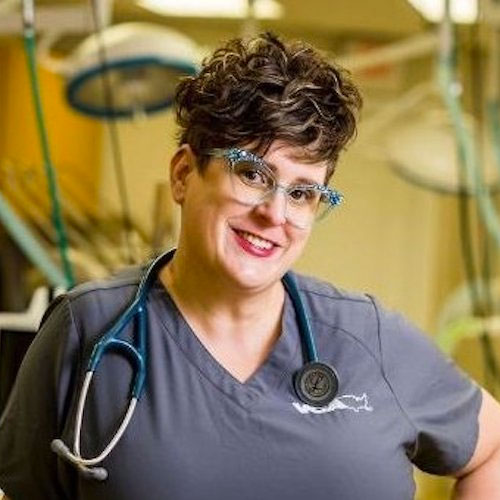
Jessica Wilson-Hess, MS, CVT, VTS
(SAIM)
Jessica is a certified veterinary technician, a veterinary technician specialist (VTS) in small animal internal medicine, and a confirmed nerd. She loves all things veterinary medicine — clinical pathology, nutrition, and caring for critically ill patients (the more IV pumps, the better). Jessica has over 15 years of technician experience. She currently works as a Clinical Evaluation and Education Specialist for Antech Diagnostics. Jessica is passionate about educating technicians and nurses about in-clinic diagnostics, advanced nursing skills, and medical case management. When she isn’t nerding it up at work, she is snuggling her pug, Tank, throwing the frisbee for Ruger, her black Labrador retriever, knitting, talking to her chickens about the meaning of life, and quilting.