S2 E2: Hypercalcemia Headache Help
S2 E2: Hypercalcemia Headache Help
Inappropriate urination and lethargy lead to a concerning finding of hypercalcemia on Louie’s labwork. Listen in as Jessica and Holly tackle the ensuing diagnostics to solve this hypercalcemia headache.
View Transcript
Welcome to Tails from the Lab, where an ever optimistic veterinarian and slightly salty technician entertain listeners with true stories and tall tales revolving around laboratory diagnostics.
Names have been changed to protect the innocent, but the lab work is real.
You can listen on your lunch break, on your commute, or when you’re hiding from your kids in the bathroom.
Each episode we hope to leave you a little smarter, a little brighter, and feeling more empowered in the lab.
Welcome to today’s tale from the Lab. Hypercalcemia headache. Help. Welcome back. I’m Holly.
And I’m Jessica.
This is Tales from the. Wow.
Excited to be here today. Recording. Um, we’ve had a busy couple of weeks.
We got to go to BMX and we were invited to speak for Dr. Cassie for Vetfolio Voice, which was awesome. They’re so well organized and put together.
They had so much support. Yes. So.
Right.
They did a live recording of their podcast and we got to be on their podcast and talk about a case from our podcast. Yeah, that’s fun.
It was really fun, but there were, like, sound checks and there was a gentleman listening to the microphones to make sure everything was going good.
I. I was hoping there was a glam squad, but I didn’t see that.
Just me, like, picking stray hairs off.
Of you, reminding me to brush my hair.
Yeah.
And I also.
Dr. Cassie and their team, what an excellent job they did, summarizing some of the points from our podcast and our delivery and our teamwork and our friendship. So our listeners should check them out if they haven’t.
Right. So Vetfolio Voice is their podcast led by Dr. Cassie, and she just does such a fantastic job.
Yeah. And I’ll put it up on Instagram when it’s released so that. That way, if you are one of our followers on Instagram, you’ll be alerted to it as well.
So we should dive in.
Yeah, I guess we should.
As often happens in Vet Med, things come in threes usually, but this came in four,
where we had four hypercalcemia patients all in the same week. And we had these discussions with different doctors on those four different cases on how to work up hypercalcemia. And we thought to ourselves, wow, that would be a really good topic for talks, for podcasts, because we seem to be having the same conversation not only with the doctors,
but also with the lab staff, with the technicians kind of working through how we work up hypercalcemia. So that’s where we’re going to start. And we will start with Louis.
So Louis is a 10 year old male, neutered spinoni. He came in for lethargy, vomiting, inappropriate urination,
and he had been prescribed recently by his primary care veterinarian some carprofen for osteoarthritis. His physical exam, there were really no significant abnormalities other than Louis is a bit stressed when he’s at the hospital.
He’s a kind of anxious guy.
And I mean, I would just like to stop and comment on the relationship that he has with his dad.
His dad is an older gentleman living alone. And so Louie is his buddy. And it was just such a really sweet, touching interaction that they had with one another and how much Louie meant to his dad.
Yeah, our pets are our family.
Yeah. It makes me get a little teary just thinking about him.
So in gathering our minimum database for Louie, we’ll start with his cbc.
There were no numerical abnormalities through the erythron, no signs of anemia or red cell indices, changes within the leukogram. There was no evidence for inflammation, at least numerically, but there was something significant through the white cell differential.
The lymphocytes actually were reported low and the eosinophils were at the low end of the reference interval. And that pattern of decreased lymphocytes and low, normal or decreased eosinophils is an indication of a glucocorticoid or stress response.
And this is a really good sick patient test. Right. So it doesn’t tell us what the underlying disease condition is. And assuming that we don’t have increased glucocorticoids from administration or from being cushionoid, then this tells us that this is a sick patient.
Whereas adrenal glands have had to secrete more cortisol to sort of withstand whatever the disease process is.
Yeah, it’s crazy how often we have these stress responses on our CBCs when we. When you really start to look for them, you start seeing them really, really often. And it’s so important that we’re not ignoring this because what a great sign for the doctors or the technicians that are helping with these cases to see on the cbc.
Yeah, because especially sometimes you’ll notice you look at where the patient’s value lies relative to the reference interval. It doesn’t always flag low, but seeing these both at the low end of the reference interval is a really sensitive indicator of underlying illness.
And.
And I think we see ADR ain’t doing right patients all the time. Right. And it’s hard to interpret behavioral changes to know there’s underlying physiologic changes, underlying pathology, contributing underlying disease.
Processes. And so the CBC is such a group of sensitive tests to give us an indication, a sensitive indication of these abnormalities. And so recognizing the stress response is, again, a really good sick patient indicator.
And I think you made a really good point about where it falls within the reference interval. Because our reference intervals are inherently wide. Just looking at that number and looking for that lower, high value doesn’t really help us.
We have to look at those speed bars or those little graphs that go to the side of our actual numeric values, because that’s going to allow us to better visualize where that value is falling within the reference intervals.
So when we’re looking at Louis cbc and I can certainly post this on Instagram, you can see that his lymphs are low, but those EOs are still within the reference interval, but they’re way down at the low end of the reference interval.
And it’s not like a value goes from being normal on one side of that line to abnormal on the other side of that line. Right. It’s just an inherent limitation of the current way we use reference intervals.
This most significant finding on his biochemical profile was an elevated calcium or hypercalcemia.
We paired the urinalysis, of course, with the CBC and the chemistry so that we were properly interpreting the abnormalities. And the urine specific gravity for his actually quite dilute urine was 1016.
So quite dilute urine, probably contributing to the fact that he was having these inappropriate accidents in the house. He probably had a very full bladder of dilute urine. No other significant abnormalities throughout the rest of the urinalysis.
So when we were putting together this podcast, our presentations on hypercalcemia, I really take such great joy in researching, like, diving deep into the physiology of these things. And also, you know, from a technician standpoint, like, what are important things to me so that I can do my job better?
And so I guess the first thing, like when I get that hypercalcemia off the printer, as the person that’s typically looking at the lab work first is, is that hypercalcemia real?
And what can I do, you know, to kind of check the boxes for these things, are, you know, I know this is true, I know this is true, or really look and see what I can do to verify that result.
So things to consider with a reported hypercalcemia from a chemistry profile,
one, did I run the right blood tube? So we want to make sure that we’re not using edta. So we’re going to either use plasma or serum, and plasma coming from lithium, heparin, so it’s whole blood.
When we spin that down, when we get off is the plasma and serum is from clotted blood. And when we spin that down,
we get serum from clotted blood.
And so not that that EDTA tube, if you got it from the plasma, would have contributed to a hypercalcemia. Right. Fairly dramatic hypocalcemia. Right?
Right.
So something that could give us spurious results on calcium measurement.
So we have to think about the age of the patient. In our large breed puppies, we can also see an elevated calcium in them.
Interfering substances, these are going to be analyzer dependent, but things like lipemia or icteris can affect the different analytes. And like I said, those are analyzer dependent. If you have a report from the reference lab, the nice thing is, is they will give you an interfering substance.
So like they’ll tell you those at the bottom and what analytes have been affected, if they have been affected.
Delay in separating plasma and serum. So we want to make sure that we’re doing that in a timely fashion. And then hyperprotinemia. So albumin and protein bound calcium. So calcium that is bound to albumin go kind of hand in hand.
So. So if you have low levels of albumin, you can oftentimes have a hypocalcemia and vice versa. If you have a high albumin, you can have a higher calcium value.
So it’s important to look kind of at the whole biochemistry panel rather than just interpreting the hypercalcemia alone.
Louis we were able to repeat the hypercalcemia on another chemistry panel. So it was persisting. So we were taking this as a real hypercalcemia. So the reported hypercalcemia on our biochemistry panel is actually our total calcium.
So it is comprised of three components. Our ionized calcium, protein bound, which I just mentioned being bound to albumin, and then complex, which is gonna be bound to like bicarbonate.
Ionized calcium is what’s biologically active and hormonally controlled. And, and that’s really what we want to measure. After we get that hypercalcemia on our biochemistry panel, we then need to follow up and verify with an ionized calcium.
Right.
It’s that ionized calcium that can get us in trouble.
Right.
That’s gonna have the biologic effects that we, the untoward effects on the kidneys, et cetera, that we worry about with our patients who are hypercalcemic.
And so just a little bit of physiology, I know we typically aren’t touching, diving into things like that. I think it’s been since acute face proteins that we did this, but.
And I’ll post this schematic up on Instagram. Our parathyroid gland is really important in the hormonal regulation of calcium. So your parathyroid gland secretes pth, or parathyroid hormone,
and it’s gonna act on a couple of different organs or tissues. One, it’s gonna go to the kidneys, and in the kidneys, it’s gonna cause an increase in calcium reabsorption, which is then gonna go into the bloodstream, and we’ to have an increase in our calcium level.
It also activates act. It also activates vitamin D, which then goes to the GI tract and causes an increase in calcium absorption from the GI tract, again going into the bloodstream, causing an increase in calcium.
Finally, that PTH will go to our bones as well and cause an increase in calcium reabsorption, causing again, an increase in calcium. So it kind of works in a couple of different ways, but the end result is always going to be that increase in calcium.
And just like many of our other homeostatic systems in our body, there’s a positive and a negative feedback. So we have low calcium, PTH is released, an increase in calcium.
As the. As that increase in calcium is recognized, we get a downregulation in that pth. So the appropriate response from our body to a hypercalcemia is a lowering of the pth.
We measured Louis ionized calcium in House using the Epoch Analyzer. It’s one of the point of care analyzers that gives you ionized calcium. And indeed, it was elevated.
And we want to make sure it’s a little bit different. Sample handling. It’s going to be lithium, heparin, whole blood that we’re using for these measurements.
I kind of talked about what I think about with the technician’s point of view, like trying to get. Trying to. To make sure and verify the hypercalcemia for you. So when I give it to you, I can say here, I’ve checked these boxes, we don’t have lipaemia.
I’m sure I didn’t run the wrong tube. Like, do you want to add an ionized calcium? You’re going to say, you’re such a good technician. Thank you so much, Jessica.
You read my mind.
You read my mind. But then what. What do you do for the doctor? Stuff that stresses me out.
So then we have to think of our differentials, right? Once you verify this hypercalcemia and that elevated ionized calcium, specifically, I think through the differentials the mnemonic for hypercalcemia in dogs I like to use is hard ions.
So for H, we think of hyperparathyroidism. This is a common cause of hypercalcemia in dogs. As Jessica talked about the importance of the parathyroid gland in regulating the calcium levels in the blood.
And so if we have an autonomous growth or tumor growth on the parathyroid gland, it’s going to increase the secretion of PTH inappropriately. Right. Without the trigger of hypocalcemia and create a hypercalcemia in the blood.
A so hard ions. A Next is Addison’s. That seemed unlikely as we had evidence for Louis in his CBC that he actually had increased glucocorticoids. Right. We talked about that.
Stress response, not decreased glucocorticoids.
Okay. R for renal disease. So renal disease can be associated with hypercalcemia. In Louis case, he had no sign of azotemia in his biochemical profile. In seeing the specific gravity of 1016, I’m going to argue in his case that I actually bet that as a result of his hypercalcemia,
rather than renal disease being the cause of his hypercalcemia. Okay, we did har Next is D. So that’s for hypervitaminosis. D’s vitamin D toxicity that can be seen with cholecalciferol exposure.
Right. That rodenticide. There are some skin creams that have high doses of vitamin D that potentially if a dog ingested it, but it’s a less common cause. Idiopathic for eye.
That’s a much more common cause in cats for their hypercalcemia than it is in dogs.
So hard ions were on O osteolysis. So different osteolytic diseases. As Jessica talked about the important role of bone and the reabsorption, that of calcium that can come from bone and bone turnover.
On in his case, that seemed less likely. There was no lameness. There are no radiographic changes, as we will soon discuss, to support any osteolytic disease. A big one for dogs.
Right. So we did H, A, R, D, I, O. Hard ions were on N. That’s for neoplasia. Right. So this is that humoral hypercalcemia malignancy that we think of in association with in dogs, an apocrine gland adenocarcinoma or T cell lymphoma.
Those being the two most common causes in dogs in cats will also include squamous cell carcinoma. And then there can be spurious causes. Right, Hard ions. But Jessica has already Excluded those spurious causes for me.
So now I think my top differentials for Louis hypercalcemia are going to be both hyperparathyroidism as well as underlying malignancy.
We have a test that we use with Louis. It’s called Neu Q and it is looking at nucleosome levels in the blood.
It’s been traditionally available at the reference lab, but now it’s coming to point of care in house diagnostics. And nucleosomes are assemblies of DNA wound around proteins. And in association with some cancers, you can get increased nucleosome levels in the blood, in particular,
lymphoma and hemangiosarcoma.
So in Louis case, an increased circulating nucleosome concentration would increase our suspicion for underlying lymphoma being one of the top differentials we’re considering for him. But fortunately, we did run his nuq, and his nuq results came back low suspicion for those malignancies it screens for.
So for the clinician, the results suggested that underlying lymphoma was less likely the cause of his hypercalcemia, although it has not been definitively excluded.
So we did some imaging, did chest radiographs and an abdominal ultrasound, and everything looked great.
Yeah, There was no indication for underlying malignancy. Next, the clinician on the case focused on the parathyroid glands. Right. So we were. Our top two differentials were underlying malignancy, which, you know, he had a normal physical exam, normal rectal exams, no evidence for an analysis.
Adenocarcinoma imaging of the chest was clear, and ultrasound of the abdomen also proved clear. So there was no overt detection of underlying malignancy. So now we focus on those parathyroid glands.
And he did ultrasound the neck. And the clinician was able to appreciate that there appeared to be an enlargement of the parathyroid gland. I think the right caudal parathyroid gland in particular, that he noted.
So what do we do now? If you can think back to the discussion about the physiology of calcium regulation in our body, we need that PTH level. We need to know where that stands within the body, whether it’s responding appropriately or not in the face of this hypercalcemia.
So that that can really help us further pick apart. Is this related to the parathyroid gland? There’s a nice test from Antech reference lab called the malignancy profile, and it measures total calcium and ionized calcium again to verify the results that you got in the in house lab.
And then it also measures pth, which is important for deciding if the parathyroid gland is responding appropriately in the face of the hypercalcemia. And then it also measures PTHRP, which is parathyroid hormone related protein.
And as Dr. Brown discussed in the hard ions,
how we can have humoral hypercalcemia, malignancy. And so this PTHRP is secreted by some cancer cells and kind of acts like pth. And so we want to also measure that as another way to exclude or include in our diagnosis of cancer.
And I always, when we’re presenting this live, I always have a little asterisk there to just say there are other underlying neoplasms that can lead to hypercalcemia for which we don’t get an elevation in the pthrp.
It’s mediated through some other mechanisms, but we have yet to identify them. So we get back Louis malignancy profile from intake reference lab, and we note that they do confirm the elevated total calcium and elevated ionized calcium that we had seen in our practice.
When we look at the PTH levels, it actually comes back within the reference interval. And his PTHRP was low or non existent.
So in teasing that apart, it was a little confounding to the clinician. Right. So the good news is that The PTHRP was 0. Right. Was not detected. So we didn’t have that as further support for underlying malignancy.
But he was surprised that the PTH came back within the reference interval. Right. Because if we’re thinking that it’s neoplasia of the parathyroid gland. Right. That’s driving that hypercalcemia, the thought would be, is that that parathyroid hormone would be measuring high.
But actually, as Jessica was talking about that important negative feedback on the parathyroid gland, and if it’s appropriately responding to hypercalcemia, that parathyroid hormone level would be low. And so the fact that it is not low, and for him it was actually nearer the higher end of the reference interval,
is inappropriate and does support underlying hyperparathyroidism.
So Louis was scheduled for a parathyroidectomy that went very well. We typically will keep them in hospital for a couple of days.
They oftentimes get jugular catheters because we’re going to be doing quite a bit of monitoring of those calcium levels because we can get some pretty big fluctuations in them postoperatively.
And when we got his histopathology results.
Back, they confirmed a benign adenoma. Right. So with complete excision. So a successful treatment for his hypercalcemia.
Yeah.
Let’S summarize. Yes, summarize this case and hit our talk our take home points. Okay, so Louis presented with non specific clinical signs, Right. It is not uncommon that our patients present with reported lethargy or GI signs without us knowing.
More specifically what’s going on in his case, there’s a little added clue of some renal involvement given that he had some inappropriate urination in the house, which was very out of character for him.
So of course, we run his minimum database. Noted on his biochemical profile was a hypercalcemia that we were able to confirm on the epoch was an elevated ionized calcium. As well,
we did imaging,
so we checked for underlying malignancy as one of our top differentials for dogs with hypercalcemia. There was no evidence on abdominal ultrasound, thoracic radiographs as well. His new Q test came back later.
Low numbers of nucleosomes in circulation, so no further support there for underlying lymphoma. And they did recognize a plump or enlarged right caudal parathyroid gland. So suspecting that he had primary hyperparathyroidism, when we sent off his malignancy profile, it came back confirming the hypercalcemia and an abnormally normal parathyroid hormone level.
So it should have been decreased, right, as an appropriate response to the hypercalcemia, and it was not. So that did support underlying hyperparathyroidism. He had a successful parathyroidectomy and recovered from that surgery uneventfully.
So our take home points, first and foremost, if you have reported hypercalcemia on your biochemistry panel, that you need to first verify that the results are not spurious. So we need to make sure they’re repeatable.
We need to kind of go through that list of things, you know, interfering substances, checking the age, making sure tube type is correct, all of those different things. And then secondly, we need to check it with an ionized calcium.
And that ionized calcium is the important part of total calcium because that’s what’s hormonally controlled and is going to cause the deleterious effects of hypercalcemia.
Our mnemonic that we can use for hypercalcemia, especially in dogs, would be hard ions. The two most common differentials in dogs being hyperparathyroidism and underlying humoral hypercalcemia of malignancy.
Thank you for listening.
Please like and subscribe to stay informed about new episodes soon to be released.
Images, lab work and other tidbits from today’s case will be posted on our website at www.antecdiagnostics.com Tales from the Lab.
And on Antech Diagnostics Instagram or you can even search for antechlab.
You can email any feedback, questions or requests for Future content to talesfromthelabantechmail.com thanks.
Again for your support.
Tales from the Lab is a production of Antech Diagnostics. The intent of this podcast is to provide education and guidance with the understanding that any diagnostic testing and treatment decisions are ultimately at the discretion of the attending veterinarian within the established veterinarian patient client relationship.
Disclaimer: This podcast intends to provide education and guidance with the understanding that any diagnostic testing and treatment decisions are ultimately at the discretion of the attending veterinarian within the established veterinarian-patient-client relationship.

Holly Brown, DVM, PhD, DACVP
Holly is a veterinarian, board-certified clinical pathologist, and figurative hand-holder. She practiced small animal medicine before, during, and after her specialty training — grateful to have combined her love of clinical practice and the laboratory diagnostics that support it. Holly remains in the trenches at a general, referral, and emergency practice. She loves making an impact at the interface of laboratory data and patient care. Holly recently transitioned into her new role as Chief Veterinary Educator for Antech Diagnostics — exercising her passion for delivering education about maximizing diagnostic testing. When away from the office, she enjoys traveling with her family, snuggling her sugar-sweet bird dog and tripod cat, and dreaming of home renovations that rarely come to fruition.
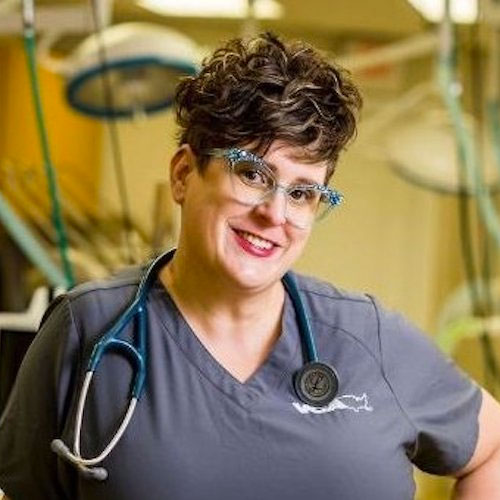
Jessica Wilson-Hess, MS, CVT, VTS
(SAIM)
Jessica is a certified veterinary technician, a veterinary technician specialist (VTS) in small animal internal medicine, and a confirmed nerd. She loves all things veterinary medicine — clinical pathology, nutrition, and caring for critically ill patients (the more IV pumps, the better). Jessica has over 15 years of technician experience. She currently works as a Clinical Evaluation and Education Specialist for Antech Diagnostics. Jessica is passionate about educating technicians and nurses about in-clinic diagnostics, advanced nursing skills, and medical case management. When she isn’t nerding it up at work, she is snuggling her pug, Tank, throwing the frisbee for Ruger, her black Labrador retriever, knitting, talking to her chickens about the meaning of life, and quilting.