Dakota’s Diagnostic Imaging: Key to Surgical Success
Signalment
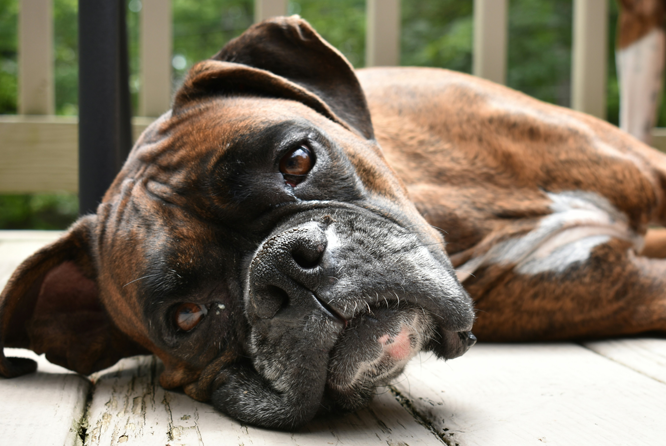
Dakota: 5-year-old female Boxer
Background: Dakota, a young and energetic five-year-old dog, presented HBC.
Author: Holly Brown (DVM, PhD, DACV)
Case Details and History
Dakota, a 5-year-old female Boxer, was struck by a moving vehicle after breaking free from her owner. In visible pain and distress, Dakota’s owner brought her in for emergency evaluation, so the responding veterinary team could provide critical care to stabilize her and address her injuries.
Intake and Physical Examination
- Upon arrival, Dakota exhibited signs of acute pain, distress, and limited mobility.
- Monitoring her vitals closely, the veterinary staff inserted an IV to begin fluid therapy and administer pain medication, and she was stabilized for diagnostic imaging.
- Dakota’s care team completed comprehensive in-house diagnostics including:
- Blood work:
- CBC on the Element HT5+™
- Chemistry panel on the Element DCX™
- A coagulation profile identifying Prothrombin Time (PT) and Partial Thromboplastin Time (PTT) with the Element COAG+™
- Blood work:
To assess the extent of her injuries, Dakota’s veterinary team utilized numerous diagnostic imaging modalities.
Diagnostic Imaging:
- Digital Radiography (X-rays):
- Dakota’s care team opted to use the Sound SmartDR™ to assess her internal injuries.
- Finding: Survey radiographs revealed an open fracture of the left tibia; no other abnormalities were seen. Dakota’s radiographs were submitted STAT to Antech Imaging Services for rapid expert evaluation.
- Ultrasound (Abdominal and Thoracic):
- Used Versana Essential™ to quickly evaluate Dakota’s soft tissue structures for internal bleeding or organ damage, contusion or possible rupture. Primary concern for Dakota’s veterinarian would be blood in the urine.
- Finding: No free fluid or signs of organ rupture were detected in Dakota’s ultrasounds.
- Computed Tomography (CT) – Full Body:
- CT was conducted with the mobile OmniTom™ Elite to rule out traumatic brain injury, intracranial bleeding, and skull fractures. This real-time CT also assessed the chest, abdomen, and pelvis for musculoskeletal and soft tissue trauma.
- Finding: No skull fractures or brain hemorrhage were identified. Mild pulmonary contusions — non-displaced rib fractures of ribs 8, 9, and 10 on the right side, with signs of cortical discontinuity and localized swelling —and soft tissue swelling (without evidence of internal organ rupture) were noted.
- 3D and multi-planar reformats were performed to further assess Dakota’s condition.
Diagnosis and Treatment
- Diagnosis:
- The diagnostic imaging identified an open compound fracture of the left tibia as the primary injury.
- CT imaging also revealed signs suggestive of non-displaced rib fractures and soft tissue swelling in the pelvic region — likely resulting from the blunt force trauma of the vehicular impact.
- Treatment Plan:
- Dakota’s veterinary care team determined that her tibial fracture required surgical intervention.
- Her rib fractures were not immediately life-threatening but would require careful monitoring due to their potential to impair respiratory function or cause secondary complications.
- Dakota’s veterinary care team determined that her tibial fracture required surgical intervention.
- Surgical Intervention:
- Pre-Procedure Supportive Care:
- Stabilization: Dakota was stabilized with IV fluids and analgesics prior to surgery.
- Antibiotic Prophylaxis: Broad-spectrum antibiotics were administered to reduce the risk of infection due to the open nature of the fracture.
- Imaging Review: CT and X-ray and Smart-C™ Mini C-arm fluoroscopy images were used to plan the surgical approach and hardware placement.
- During Procedure & Surgical Technique: Dakota underwent an open reduction and internal fixation (ORIF) procedure to repair the compound fracture of her left tibia.
- Surgical Process:
- Debridement: The wound was thoroughly irrigated and debrided to remove contaminants and necrotic tissue.
- Fracture Reduction: The tibial fragments were realigned anatomically using real-time fluoroscopic guidance with Smart-C™ Mini C-arm to create a new joint angle.
- Internal Fixation: A locking compression plate (LCP) was selected for its stability and ability to accommodate soft tissue swelling.
- Screws were placed proximally and distally to secure the plate and maintain alignment. Bone graft material was considered to support healing due to the severity of the fracture.
- Soft Tissue Management: Muscle and fascia were carefully repositioned.
- The skin was closed using layered suturing to minimize tension and promote healing.
- During surgery, Dakota was placed on supplemental oxygen and closely observed for signs of respiratory distress, including increased respiratory rate, shallow breathing, or abnormal lung sounds.
- The surgery was performed under general anesthesia with continuous monitoring of vital signs and pain management to ensure Dakota could breathe deeply and avoid complications such as atelectasis or pneumonia.
- Fluoroscopic Evaluation with Smart-C™ Mini C-arm: Enabled real-time assessment of joint mobility post-surgery, confirming proper alignment and eliminating the need for revision.
- Surgery Outcome: Surgery was successful with no complications.
- Surgical Process:
- Pre-Procedure Supportive Care:
- Post-Operative Rehabilitation:
- Wound care and infection prevention measures.
- Strict activity restriction for 6-8 weeks.
- Follow-up imaging:
- Repeat thoracic radiographs or ultrasound to monitor healing and rule out delayed complications from the rib fractures such as pleural effusion or pneumothorax.
- Gradual introduction of passive range-of-motion exercises to prevent joint stiffness and muscle atrophy.
- Regular follow-ups to monitor healing.
- Course of laser therapy treatments to help with healing and inflammation.
Case Impact
Thanks to timely surgical intervention and appropriate post-operative care, including from numerous diagnostic imaging modalities and in-house diagnostics, Dakota made a full recovery. After a successful surgery and a gradual return to therapeutic physical activity, Dakota’s long-term prognosis is favorable, though she may require ongoing monitoring for orthopedic healing and potential complications.
Smart-C™ is the trademark of Turner Imaging Systems, Inc. OmniTom™ is the trademark of NeuroLogica Corp. Logiq™ e Vet and Versana Essential are the trademarks of GE Healthcare.
© 2025 Antech Diagnostics, Inc. All rights reserved.