S1 E6: The ABCs of APPs
S1 E6: The ABCs of APPs
Jessica and Holly unwrap some of the challenges in diagnosing and trending inflammatory disease in our veterinary patients and discuss the clinical application of acute phase protein measurement in such instances.
View Transcript
Welcome to Tales from the Lab, where.
An ever optimistic veterinarian and slightly salty.
Technician entertain listeners with true stories and tall tales revolving around laboratory diagnostics.
Names have been changed to protect the innocent, but the lab work is real.
You can listen on your lunch break, on your commute, or when you’re hiding from your kids in the bathroom.
Each episode, we hope to leave you a little smarter, a little brighter, and feeling more empowered in the lab.
Welcome to today’s tale from the lab. The ABCs of the apps. Why would that be the one that popped up?
Psych. We’re changing. Okay, Here we are.
So in veterinary medicine, recognizing, diagnosing,
and we’ll argue, trending inflammatory disease has to be one of the most important things that we do in our medical workups of patients.
So if we think about. Obviously, histories can be very vague and our physical exam is somewhat limited sometimes. Right. Especially when we think of, you know, the five cardinal signs of inflammation.
And we think of animals masking what they can. Or cats presenting reactive, stressed, increased heart rate, don’t want you palpating their abdomen. And it’s only because they hate being at the hospital.
Yeah. And I think how many times have we heard owners say, I feel stupid because they. They were sick at home, but now they’re fine.
Yes.
Like, they’re just. Animals are so good at hiding being sick. It. It really is tricky in the animal hospital. And, you know, that’s one of the things that I always like to ask owners is on a scale of 1 to 10, you know, 1 being laying around and 10 being super happy,
where. Where do you rate your dog? Not right now, but when they are at home in their natural environment because it is. They’re just so great at, you know, putting on a facade when they come.
To the vet hospital to get back home so you don’t have to hang out with us.
And I think that when we think of getting objective information about inflammatory disease, we naturally think about hematology and the cbc. We talk about an inflammatory leukogram, and classically, that’s a leukocytosis characterized by neutrophilia plus or minus a monocytosis.
Right. So that’s the classic leukogram. But as you said,
it doesn’t. These inflammatory cases, as we see day in and day out at the hospital, they don’t always read the books. Right. And that has to do with the hemodynamics.
Right. Of tissue demand for the inflammatory cells for the neutrophils and the bone marrow production. And we’re catching them at a moment in time, right, when they’re in circulation.
So when I think about hallmarks of inflammation, it wouldn’t be the inflammatory leukogram, because I think that is, it’s insensitive to detecting inflammation. And in truth, it’s about recognizing the increased demand on the bone marrow by seeing bands in circulation.
Right. An example I give when I give these talks is thinking about something like an aspiration pneumonia case.
And if my dog aspirates, so I check their blood before they aspirate, no inflammatory leukogram, no leukocytosis, neutrophil count within the reference interval, they aspirate, right. Moments later, no change.
Right? But as the inflammatory cytokines are released from the lungs, right, Saying, ah, we have an infection, we have debris here, we need some help. Then those inflammatory cytokines, they are going to call, right, the neutrophils, to the source of inflammation.
And so there’s a moment in time where the neutrophils are going to leave the blood, right? And the cell count can actually be low. And it’s not because we don’t have inflammatory disease.
We have an intense inflammatory disease. Right? So we have a circulating pool of neutrophils, right? Let’s say for my dog in health, that’s 8,000 neutrophils per microliter. We have about equal numbers in the bone marrow and a storage pool of mature neutrophils, right.
That we don’t often think about. They can be released pretty rapidly from the marrow in response to those inflammatory cytokines. So then they will replace those that we just lost from circulation.
So then there’s a period of time that the neutrophil count falls within the reference interval again, and they’re mature neutrophils. And so we, these are the cases we see commonly where they don’t have this inflammatory leukogram because total cell counts may be within the reference interval.
Boy, that makes it really tricky to know. Like, if you’re just looking at the data, it makes it really tricky to know where you are in that process.
Yeah, right. One time point is not adequate. And then if those 8,000 of mature neutrophils come into circulation and then they go into the tissue as well, Right. At this point, we have the bone marrow ramped up, right?
And it’s going to start to release some of the more immature neutrophils, right? It’s going to mature them more quickly, but then release them rapidly because they’re needed. Right. And by the tissue, the demand is so high.
So now it’s capturing those young neutrophils, those bands, maybe metamyocytes, maybe earlier precursor cells in circulation. Now, that’s the hallmark of intense inflammatory disease,
regardless of what the numbers are. Right. So the numbers might be high, low, or within the reference interval. But if I’m catching those more immature forms of neutrophils, it’s because the demand was so high that the circulating pool of mature neutrophils were not adequate to meet that demand.
The storage pool of mature neutrophils were not adequate to meet that demand that we had to release earlier forms from the bone marrow to do so.
So how do we recognize bands? That sounds easy, right?
Except it’s not.
It’s not.
Yeah, it’s really. It’s not. And I think there’s so much variability from person to person or who trained you, you know, who is your mentor that’s taught you to visualize those.
And I think that if you showed five clinical pathologists the same cells, there would be disagreement between them 100%.
And I, I thought that as a trainee,
as a clinical pathologist, that having been trained specifically on blood films and hematology and recognizing left shifts, that I was pretty good.
But it turns out, you know, working at the hospital here and being close to these cases and looking at the data each day as we treat inflammatory disease and, and me being the one to decide, right.
Whether this is getting better or worse, responding to treatment, looking at a blood film is totally inadequate. We say the hallmark of inflammatory disease is detecting bans, and yet we don’t have a great objective way to do that.
Right. So it helps on some of our hematology analyzers that it can use certain characteristics of a cell to identify their immaturity.
So you may have access to a hematology analyzer at point of care at the reference lab that would help identify these left shifted cells and recognize inflammation. And if they can do that objectively, it’s something that we could trend.
Right. But we don’t have direct access to those numbers. And there’s still a person’s interpretation of that layered on top of it, which adds subjectivity.
So we’re going to talk about acute phase proteins.
So we have another suggestion on how we can assess and trend inflammatory.
Yeah, And I think it’s important to look at these as all tools in your toolkit. Like, you know, using your hematology analyzers.
Scattergrams is one tool. You know, looking at A blood film is another tool. And these acute phase proteins, I think when used appropriately can be a really nice tool to identify the inflammation.
And, and it is like a, a, a solid number. You know, it’s not, it doesn’t have that loosey gooseiness of interpreting bands.
Absolutely. And we are, we are looking for numbers so that we can trend them. That helps us.
So before we can talk about acute phase proteins, we need to talk about the acute phase response.
So what, this is basically the process that ends up in their production.
So in our body we have some type of inflammatory stimulus that occurs. Tissue injury, infection. So we have some type of inflammatory stimulus and then we get activation of our monocytes and macrophages that release cytokines.
These are things like Illinois 1, Illinois 6, tumor necrosis factor alpha. And those get released and they do a multitude of things. And we are certainly not going to talk about all of those.
But one of the things that we’re going to talk about is their effect on the liver. And these cytokines cause the release of acute phase proteins or, or in the case of negative, because there’s both positive and negative acute phase proteins, they either cause the upregulation or the downregulation of these and then those help with the systemic response of things that we typically think of when we think of inflammation,
things like fever. I left the hematologic change, which is a leukocytosis for last, because that’s what we, you know, on our CBC data, that’s what we really are looking about.
Dr. Brown talked about the, you know, aspiration pneumonia case and how we see kind of a lag in that leukocytosis. So we may have an intense inflammatory response and that’s going to be a little bit delayed to see that leukocytosis on blood.
So these acute phase proteins are going to be plasma proteins. I said that they’re primarily produced by the liver in response to inflammation.
We get level changes in these by at least 25% during inflammation. And a really key point to think about with acute phase proteins is they are not stored in the body.
So these are going to respond to the systemic inflammation that we’re seeing. So they are going to be a better, I guess, in time, you know, measurement, reflection of the inflammation that we’re seeing.
And I stated that there are negative and positive acute phase proteins.
So when we were doing, you know, kind of the literature searches and the review for this, I was, I guess not surprised because I know that we use albumin as a measurement of Inflammation, but I didn’t actually think about it as a negative acute phase protein.
Right. And so, and while maybe because we, we don’t talk about as a measurement of inflammation so much. Right. But we do know in our sick, hospitalized patients with inflammatory disease, we watch albumin creep down and down and down, right.
When they have active inflammatory disease. And so you knew that was a consequence of, but not why.
Yeah, yeah. And it’s postulated. And this is like so cool because the body is so good at trying to maintain homeostasis. And so when we have this increased call for these acute face proteins, the positive ones, what albumin does is it, you know, it decreases in production to make amino acids available for these positive acute phase proteins that need to be produced.
And positive acute phase proteins can be broken into three classifications, major, moderate, and minor. The major ones, which are going to be the things that we’re going to focus on are going to be ones that have a greater than 10 fold increase, moderate have a 5 to 10 fold increase,
and minor proteins have a much more gradual increase and gradual decrease. So those major acute phase proteins go up very quickly in response to inflammation, but also go down very quickly.
Get a comparison of the different measurements that we can use to assess for active either increasing inflammatory disease, progressive inflammatory disease, or resolution. And we’ve talked about, Jessica’s talking about looking at the acute phase proteins when we look at sort of a time graph, if you will, of when you’re going to see the changes again initially.
And there’s the initial inflammatory stimulus. White cell count will go down pretty quickly as these leukocytes extravasate into the tissue source of inflammation.
Right.
So that goes down, but then it’s stuck up as the bone marrow is responding. And it can be during those acute phases, the hours to days of inflammatory disease, they can almost be anywhere in that zone of being under the reference interval, within the reference interval, or increased, you know,
usually dropping initially and then gradually increasing throughout the course of that.
In contrast, the major acute phase protein, starting at a negligible baseline inflammatory stimulus, hits within hours. It rises more than tenfold, as you said, it remains high. While that inflammatory stimulus is high, the inflammatory stimulus resolves or is resolving and it’s dropping within hours.
Right. So a classic example of that sensitivity in comparison to looking at leukocytes, another one would be like a pyometra, Right? So these are a little slower in onset. So we have enough time for those neutrophil counts, the inflammatory cells, to rise in the blood.
So they often present with A leukocytosis characterized by neutrophilia, usually a left shift. We make the diagnosis, we take them to surgery. Those inflammatory cytokines were so high because of this infection.
Right. So we are spitting out a lot of these inflammatory cells from the bone marrow in response, and then we remove that tissue, source of inflammation within hours. Right. So they go to surgery, we remove that, but it doesn’t just go away.
Right. Those inflammatory cytokines are high. And we know that post operatively we just took away the exit route for those neutrophils that they were all dumping into the uterus. And now the next day they’re up at 90,000.
Yeah. And I can just think of some of our younger doctors that have their first pyometras and they are freaking out the next day, like, and just trying to like, tell them like, this is normal, like this is what we normally see, like it will get better.
But that’s where acute phase proteins could be really nice to make us feel a little warmer and fuzzier about the treatments that we’re confident. Yeah, yeah. Because we can go back and we can measure them.
If we’re keeping our blood samples, which we would 100% advocate for, get a Ziploc bag, write the date on there, put them in the fridge. Because how many times have we gone back and wanted to do something like we needed to do a test and the blood got thrown away.
And in particular, acute phase proteins work so well for us because they’re stable for so long.
Right.
Even up to every two weeks at room temperature.
Yeah.
That’s nutty. Yeah.
And we oftentimes, because we do keep seven days of blood in the refrigerator, in the lab, you know, in their labeled Ziploc bags, we often will go back to three days ago, measure the acute phase protein, then day two, then our current day, just so that, that way we can see where those,
that where is, where is that trending? Because it does change so quickly.
Yes. And we’ll talk about cases for this specifically. But it does help us when, you know, the reason we didn’t do them in time was that we thought we understood the disease process and we had our appropriate treatment protocol.
But when things don’t go well or go as expected,
whether it’s a clinical picture or something else happening in the blood work, we’re now going back and want objective information to say, are we getting better? Are we not?
So in the dog, the major acute phase protein is C reactive protein. Oftentimes you’ll see it abbreviated as Just capital crp,
or when people talk about it, we call it crp.
And this is really a great analyte to measure. Like we said, you can go back in time.
Its stability is 14 days refrigerated or room temp 3 months frozen. You can get CRP measurements from serum heparinized and EDTA, plasma, joint fluid, spinal fluid. So there you have a multitude of options to measure this.
And I think you will hear us talk lots and lots about making sure to trend it,
knowing where we’re kind of starting out, and then being able to see where we go based on our treatment.
In the cat, the major cute phase protein that we think about is serum amyloid A or saa. If you are an equine practitioner, I’m sure you’re probably familiar with serum amyloid A.
And again, the stability is really great. Room temperature is preferred for SAA over refrigeration and it has greater. Anything that is older than 24 hours, we should really try to freeze.
So that’s like the only kind of caveat with cats. And frozen, it’s stable, stable for three months. And again, we can measure it in serum heparinized and et, edta, plasma and then various body cavity fluids.
So when are we measuring the acute phase proteins? Right. You know, when we’re working during the daytime hours. Right. And we get involved in the cases, we’re tying together a bunch of different tools to diagnose and trend inflammatory disease.
Disease. But I think a lot of. I think about our doctors, you know, on the overnight shifts, the weekend shifts, those working, you know, we’re 24, 7 at the hospital, and without a clinical pathologist or an experienced laboratory technician being able to help them with some of these more advanced tests,
if you will.
I think that especially an animal coming in on emergency. Right. Or an ADR patient and being able to try to figure out how sick is this animal. Right. Like is.
Again, is it a behavioral change? Is something else going on? We have a bunch of different tools we talked about. We love hematology for assessing, you know, health versus sickness, just as a screening test.
Obviously, our chemistry helps us look at organ function, et cetera, urinalysis. Always important to pair with the others. Right. We have a lot of different tools. Imaging, of course. Right.
Those are all tools in the tool chest. Being able to give our practitioners a tool that they can assess for the systemic inflammatory process and get a number on that to say no sign of systemic inflammatory disease versus this is really high.
We have justification to do more diagnostics to figure this out.
Yeah. And I think it’s really nice for clinicians to be able to say to owners, here’s what our normal range is. And we are, you know, 10 times the normal range.
Like that’s, that’s a big jump that. That is able to tell them, you know, something is really going on. And I guess on the other end of that, to be able to show the owner, here’s where we started.
And now we’re down to, you know, we’re half that. We’re half that. Now we’re back into the normal range.
And I think so it’s a very sensitive marker for systemic inflammation, but it’s not specific. Right. So it says, yes, there’s a tissue trauma, there’s an infection, there’s something stimulating the systemic inflammatory response and these app production.
Right. But we need to look further to figure out, right. We think of all the classic infectious diseases like pyo, anything pyometra, pyothorax, pyoabdomen,
all of those conditions, immune mediated conditions. Right.
Whether that’s a polyarthritis, imha, we expect it to be high, but extensive tissue trauma, even surgical tissue trauma, can increase it. We think of pancreatitis. Oh, pancreatitis in dogs in particular.
Right. Those severe canine pancreatitis cases. So we talk about using it to establish our diagnosis, to identify inflammatory disease and quantitate it. Right. And that helps us because we can get a number on it.
And then most importantly, trending that it’s not an overly expensive test. There are some point of care options right. For it. And so I think that giving the opportunity to take more than one time point is really where it shines as a test.
Because just knowing we have inflammatory disease doesn’t. The ball doesn’t stop there.
Yeah. I think that’s a really interesting comment that you just made because I would also like to piggyback on that, that when you’re. Whenever you’re trending any of these, whether it’s your CBC or CRP or another one of the apps, you want to try to use the same instrument.
Because there can be variability from point of care instruments between them and also between point of care and the reference lab.
Oh, that’s so such a good point.
That’s like two gold stars for me.
Amazing.
Maybe I should just drink a whole bunch of espresso every time.
So do you want to share a case with your sort of one of your earliest experiences with measuring crp?
Yes. So I have a dog niece. Her name is Daisy. She’s A little chihuahua. And her mom is. I love her very much. She’s my sister in law. She’s very hyper focused.
Her dogs are her children. And Daisy was sick. So she brought Daisy to the animal hospital and she actually had gallbladder disease. So we, there was an ultrasound, it was distended.
There really wasn’t a mucous seal, but it, it just was really dematous and swollen.
No fluid at that point in time.
No abnormal effusion?
No. Nope.
But she continued to get worse and worse.
So we ended up doing surgery on her and exploratory and ended up removing her gallbladder. It was very ulcerated and angry and it was just a very unhappy gallbladder. So she got a feeding tube because she hadn’t been eating and she was hospitalized.
So her mom, you know, we’re talking every day, how’s she doing? And clinically she really wasn’t doing awful, but she wasn’t improving, she wasn’t eating on her own. Her mom was very stressed.
And so I talked to Holly and I talked to the doctor on her case and we decided to do some serial crp. So we looked at the day of presentation and you know, her CRP at that point was I think eight times normal.
And then the day after surgery, we looked at it and it had halved. And the following day it had halved again. So I was able to talk to her mom and let her know, like, even though we aren’t like feeling better, we’re not eating on our own, but we have that feeding tube in so we can take care of that.
She really, we were able to kind of guide when Daisy went home based on those CRP values, which is, it was an awesome feeling to be able to explain to mom, here’s what the, here’s what an acute phase protein is.
Here’s. Here’s why we’re measuring it. Here’s where we were when we started. Here’s where we were, you know, a day later and then a day later. And I think as a technician,
I can wrap my brain around an app because it’s just one. One value. And I understand that that’s very myopic. It’s not, you’re not looking at the whole picture, but I can wrap my brain around it a little better.
And I think it’s easier to explain to owners than the entire cbc. Of all the nuances of. We’re looking at this and this and this. It just gives us a.
Easier tool to communicate with owners.
Yes. And so that’s so My story I’ll share highlights exactly that. So again, early on in us having access to running CRP in clinics. So yours was. We are probably talking within the same couple weeks.
Right. So Panzer was a senior dog, I think a male neutered Skipper Key or Mex breed.
And mom had actually seen Panzer vomit. Panzer had eaten some diapers and mom watched him vomit and saw him aspirate, actually. So when she went to the referring vet, Panzer had a known diagnosis of aspiration pneumonia.
They saw intense inflammatory disease. They had hospitalized him on broad spectrum antibiotics, IV fluid therapy,
other supportive medications. And so he had been hospitalized at the referring vet for three days and he was not clinically getting better. And so they referred him to our hospital for some elevated care.
He came to our hospital, we upped some of his respiratory care, maybe we had given some plasma, other things to help him with his systemic inflammation.
And similarly, he remained depressed in our hospital as well. Right. So now we have a senior dog who’s been hospitalized. He was with us for three days. Now I’m coming in on a Saturday morning because such a good doctor, Such a good doctor.
I care. I do care.
You do actually care. I’m sorry to mock you.
And so the clinician had said, you know, mom is wondering if we’re getting to the end of the rope, like, is this not fair to Panzer, this 12 or 14 year old dog, like, if we’re not going to get better, she’s feeling pretty sorry for him and he’s really, really depressed.
And I said, well, let me come in and see what I can contribute to the case diagnostically.
So I had come in and I was looking at the blood work and trending it for the three days that Panzer had been hospitalized. And there were some subtle changes, not necessarily in the numbers of the leukogram because those are sometimes inconsistent, but there were some subtle changes in the distribution of the cells.
And as I looked under the microscope, you know, less of a left shift, less toxicity. And so I couldn’t show her that things were subtly improving, but I could see that on my end of things to suggest, like, I think we are on track and I think that there’s a good chance that Panzer’s depressed because he’s been hospitalized now for a week as a senior dog.
He just wants to be home. Right. I believe we’re on the right course of antibiotics. Our toxicity is gone.
Right.
It’s not like we get a chance to culture these. So it’s a mystery of what’s in there. You know, we Put them on something. Broad spectrum, might be antimicrobials. But I said, we, I do have something I can show her.
Let us go back and look at his CRP measurement from when he came in three days previously. Let’s take a measurement from each day’s blood work. Right. And I was able to trend that for her and say he came in at a certain level, high, intense and systemic inflammation.
Right. That we recognize there. But we had reduced that number by more than 50% in the three days he had been hospitalized with us and actually like getting reasonably close to resolution of that systemic inflammation.
And I said, based on what I’m seeing here, I think you might want to try him at home for a night. Like, I. I think you may see the clinical improvement you are looking for in his behavior.
Because I see from my standpoint that we have made strides in his inflammatory process. I think we’re on the right antibiotics. I think that it’s worth trying him at home.
And I felt like I had such a great tool to show her that, that she could wrap her mind around because me talking about resolution of toxic change on a blood film, you know, is lost.
Especially this communication with her. She’s very emotional. She’s thinking about euthanizing her beloved pet. Right. And so I could see, see that my words weren’t sinking in. I think that CRP was a great tool for us.
Yeah, it’s a really nice tool.
Yeah. I, again, at the risk of sounding over dramatic, it saved his life. Yeah, it literally saved his life. Yeah.
And I mean, we do. We have multiple cases where we have seen similar things. You know, being able to talk to owners, being able to evaluate treatment, being able to know when something went wrong.
I mean, surgeons are grateful.
Yeah, it really, it works very nicely.
Thank you for listening to today’s Tale from the Lab.
Please like and subscribe to stay informed about new episodes soon to be released. You can also email any feedback, questions or requests for future content to tales from the labanttechmail.com thanks again for your support.
Tales from the Lab is a production of Antec Diagnostics. The intent of this podcast is to provide education and guidance with the understanding that any diagnostic testing and treatment decisions are ultimately at the discretion of the attending veterinarian within the established veterinarian patient client relationship.
Disclaimer: This podcast intends to provide education and guidance with the understanding that any diagnostic testing and treatment decisions are ultimately at the discretion of the attending veterinarian within the established veterinarian-patient-client relationship.

Holly Brown, DVM, PhD, DACVP
Holly is a veterinarian, board-certified clinical pathologist, and figurative hand-holder. She practiced small animal medicine before, during, and after her specialty training — grateful to have combined her love of clinical practice and the laboratory diagnostics that support it. Holly remains in the trenches at a general, referral, and emergency practice. She loves making an impact at the interface of laboratory data and patient care. Holly recently transitioned into her new role as Chief Veterinary Educator for Antech Diagnostics — exercising her passion for delivering education about maximizing diagnostic testing. When away from the office, she enjoys traveling with her family, snuggling her sugar-sweet bird dog and tripod cat, and dreaming of home renovations that rarely come to fruition.
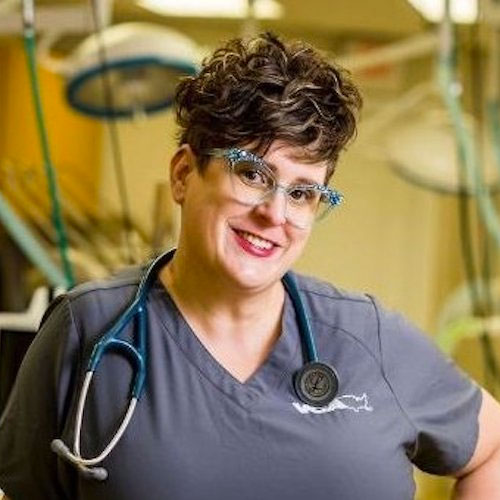
Jessica Wilson-Hess, MS, CVT, VTS
(SAIM)
Jessica is a certified veterinary technician, a veterinary technician specialist (VTS) in small animal internal medicine, and a confirmed nerd. She loves all things veterinary medicine — clinical pathology, nutrition, and caring for critically ill patients (the more IV pumps, the better). Jessica has over 15 years of technician experience. She currently works as a Clinical Evaluation and Education Specialist for Antech Diagnostics. Jessica is passionate about educating technicians and nurses about in-clinic diagnostics, advanced nursing skills, and medical case management. When she isn’t nerding it up at work, she is snuggling her pug, Tank, throwing the frisbee for Ruger, her black Labrador retriever, knitting, talking to her chickens about the meaning of life, and quilting.