
Chez Antech™, nos services de microbiologie sont conçus pour offrir aux vétérinaires des réponses fiables. Grâce à des diagnostics avancés et à un accompagnement expert, nous vous aidons à :
- Permettre une identification précise des agents pathogènes microbiens
- Choisissez les options de traitement les plus efficaces
- Améliorez les résultats des patients en toute confiance
Nous sommes également engagés dans une perspective plus globale : la lutte contre la résistance aux antimicrobiens (RAM). En suivant les dernières recommandations du CLSI et les niveaux de prescription d’antibiotiques publiés par l’Agence européenne des médicaments (EMA), nous favorisons un usage responsable des antibiotiques, vous aidant ainsi à protéger non seulement vos patients, mais aussi la population en général.
Découvrez les nouvelles améliorations apportées au panneau MIC et le rapport HealthTracks :
Des questions concernant nos mises à jour MIC ?
Qu'est-ce qui change dans la façon dont le Antech signale les MIC pour les chiens et les chats ?
Les dernières mises à jour permettent à Antech de fournir les concentrations minimales inhibitrices (CMI) et les résultats de sensibilité selon les recommandations les plus récentes du Clinical and Laboratory Standards Institute (CLSI) spécifiques à la médecine vétérinaire, et non plus selon les seuils de sensibilité humaine. Ce changement vise à aider les vétérinaires à prendre des décisions thérapeutiques plus précises et encourage un usage responsable des antimicrobiens. De plus, ces rapports mis à jour sont disponibles exclusivement sur HealthTracks. Vous n'êtes pas encore inscrit sur HealthTracks ? Cliquez ici pour vous inscrire dès aujourd'hui.
Qui est le CLSI et pourquoi est-il important pour la médecine vétérinaire ?
Le Clinical and Laboratory Standards Institute (CLSI) est une organisation internationale à but non lucratif qui élabore des lignes directrices consensuelles pour les analyses de laboratoire, notamment en microbiologie et en antibiogramme (AST). Le CLSI réunit des experts en santé vétérinaire et humaine afin d'établir des normes fondées sur des données probantes, garantissant ainsi l'exactitude, la pertinence clinique et la reproductibilité des résultats de laboratoire dans différents contextes. Le CLSI publie des documents spécifiques à la médecine vétérinaire (par exemple, VET01, VET02, VET06, VET09 dans la section « Pour en savoir plus ») qui décrivent les méthodes d'analyse, les seuils de sensibilité et les critères d'interprétation propres à chaque espèce, notamment pour les chiens, les chats et les chevaux.
Quelles modifications les directives du CLSI ont-elles apportées à l'interprétation des CMI vétérinaires ?
Le CLSI a mis à jour ses lignes directrices relatives aux tests de sensibilité aux antimicrobiens vétérinaires afin d'améliorer la précision et la pertinence de l'interprétation des CMI chez les animaux. Les principaux changements apportés à ces lignes directrices sont les suivants :
- Seuils de tolérance vétérinaires spécifiques pour des espèces comme les chiens et les chats
- Nouvelle catégorie « Susceptible, dose-dépendante (SDD) » pour les options de traitement ajustées à la dose
- Seuils de sensibilité révisés pour certaines combinaisons médicament-pathogène
- Des normes de compte rendu plus claires pour favoriser la cohérence et la prise de décision clinique
Quelles sont les catégories EMA que je vois dans le rapport et pourquoi sont-elles importantes ?
Antech propose désormais des niveaux de prescription suggérés pour les antimicrobiens, classés en quatre catégories : Éviter, Restreindre, Prudence et Utilisation raisonnée, afin d’orienter le choix et de favoriser un usage raisonné. Ces niveaux sont attribués au médicament en fonction du risque de résistance aux antimicrobiens et de son importance pour la santé humaine.
Pourquoi Antech a-t-il utilisé les catégories EMA au lieu d'un autre système ?
Nous avons choisi les catégories de l'EMA (Agence européenne des médicaments) pour leur clarté : leur origine importe moins que leur rôle pratique dans la promotion d'un usage réfléchi et responsable des antimicrobiens pour chaque patient. (Voir la section « Interprétation » pour savoir comment les utiliser.)
Pourquoi Antech a-t-il supprimé les recommandations posologiques des rapports ?
Chaque patient est unique et la posologie efficace et sûre dépend de nombreux facteurs, notamment la fonction rénale et hépatique, l'observance du propriétaire et les contraintes pratiques. Pour adapter le traitement, nous vous encourageons à consulter des ouvrages de référence fiables comme celui de Plumb.
Consultez le Manuel des médicaments vétérinaires, les recommandations de l'ISCAID ou de l'ACVIM, ainsi que d'autres ressources en pharmacologie. Dans les cas particulièrement complexes, l'avis d'un spécialiste peut s'avérer précieux.
Ces mises à jour sont uniquement disponibles dans HealthTracks. Pourquoi les rapports MIC ne sont-ils pas mis à jour dans AntechOnline ?
AntechOnline est notre plateforme historique et n'est plus mise à jour. Afin d'offrir le meilleur soutien aux vétérinaires, Antech investit dans HealthTracks, notre plateforme de diagnostic numérique unique conçue pour proposer des innovations continues, des flux de travail simplifiés et des rapports améliorés. HealthTracks fournit l'assistance diagnostique complète dont nos clients ont besoin, tandis que AntechOnline ne peut plus répondre pleinement à ces exigences croissantes. Pour bénéficier des fonctionnalités et des résultats les plus récents, nous vous encourageons à utiliser HealthTracks.
Notre clinique n'a jamais utilisé HealthTracks auparavant. Comment pouvons-nous accéder à ces nouveaux rapports MIC ?
Vous pouvez vous connecter à HealthTracks avec les mêmes identifiants que pour AntechOnline. Si vous préférez que les résultats MIC soient envoyés directement à l'adresse courriel de votre hôpital, veuillez contacter l'assistance HealthTracks à l'adresse [email protected] pour mettre à jour vos préférences de messagerie.
Veuillez noter que les rapports de télécopie ne sont pas encore disponibles avec ces nouvelles fonctionnalités, mais le seront prochainement.
Je consulte mes résultats uniquement via mon logiciel de gestion de cabinet et je n'ai pas d'identifiants sur HealthTracks ; comment puis-je accéder au rapport le plus complet ?
Les clients qui accèdent à leurs résultats via une interface PIMS intégrée continueront à voir les MIC et les interprétations S/I/R de la manière dont leur PIMS choisit d'afficher ces données ; cependant, les vues PIMS dépendent de l'éditeur du logiciel et les nouvelles fonctionnalités spécifiques à Antech ne sont disponibles que dans HealthTracks.
Si vous préférez que les résultats MIC soient envoyés directement à l'adresse électronique de votre hôpital, veuillez contacter le support HealthTracks à l'adresse [email protected] pour mettre à jour vos préférences de messagerie.
Remarque : les rapports de télécopie ne sont pas encore disponibles avec ces nouvelles fonctionnalités, mais le seront prochainement.

Écoutez notre épisode de podcast sur les dernières mises à jour de MIC !
Meera Surendran Nair (DVM, MS, MSCTR, PhD, DACVM), microbiologiste et immunologue vétérinaire certifiée, directrice des maladies infectieuses chez Antech™ et microbiologiste et immunologue vétérinaire certifiée, rejoint Histoires du laboratoire Elle abordera les récentes mises à jour concernant les rapports de sensibilité aux antimicrobiens et les seuils cliniques. Elle expliquera comment ces changements influencent le diagnostic vétérinaire et les décisions thérapeutiques, aidant ainsi les cliniciens à choisir l'antibiotique approprié à la dose adéquate pour traiter efficacement les infections tout en minimisant l'exposition inutile aux antimicrobiens.
Chez Antech™, la microbiologie signifie plus
Nous fournissons des diagnostics microbiologiques précis, opportuns et exploitables qui permettent aux vétérinaires de prendre des décisions de traitement éclairées, améliorant ainsi la santé animale, réduisant la résistance aux antimicrobiens et favorisant de meilleurs résultats cliniques.
Ce qui nous distingue
Délais d'exécution rapides
Des résultats rapides au moment où ils comptent le plus — avec des résultats positifs de culture aérobie et urinaire et de sensibilité rapportés en seulement 48 à 72 heures.
Ressources intégrées
Des outils pédagogiques, des FAQ et l’accès à notre équipe de consultation vous aident à interpréter les résultats et à gérer les cas complexes en toute confiance.
Rapports cliniquement pertinents
De l'identification des agents pathogènes aux profils de résistance, nos nouveaux rapports HealthTracks.com sont clairs, exploitables et soutenus par des informations microbiennes d'experts.
Soutien à la gestion des antibiotiques
Les recommandations fondées sur les données guident les thérapies ciblées, réduisant ainsi le recours aux traitements empiriques et favorisant une utilisation responsable des antimicrobiens.
Expertise spécifique à l'espèce
Qu'il s'agisse d'animaux de compagnie, exotiques ou équins, notre équipe comprend les défis microbiologiques uniques à chaque espèce.
Notre engagement
Nous nous engageons à être votre partenaire en soins vétérinaires. Grâce à notre rigueur scientifique et à notre empathie clinique, nous vous permettons de prodiguer les meilleurs soins possibles à chaque patient, à chaque fois.
Du spécimen au code
Par où commencer ?
Envoyer un échantillon devrait être simple. Voici comment nous vous facilitons la tâche, du prélèvement à la sélection du code.
Flux de travail général
- Déterminer le type d'échantillon à soumettre
- Soumettez votre spécimen en suivant notre directives de collecte
- Les échantillons sont traités dans l’un de nos laboratoires de pointe aux États-Unis et au Canada.
- Résultats:
- Présence ou absence de bactéries signalées en 24 heures
- Résultats d'identification de la culture et de sensibilité rapportés dans 2 à 4 jours.
Exemples de directives et de codes de test
- Urine
- M130 (Canada : CM130) – Culture d'urine avec FIRSTract™
- Peau
- M020 (Canada : CM020) – Culture, aérobie
- M040 (Canada : CM040) – Culture aérobie/anaérobie
- M080 (Canada : CM080) – Culture fongique
- M240 (Canada : CM240) – Culture, Dermatophytes
- Sang
- M060 (Canada : CM060) – Culture, aérobie sanguine seulement
- M061 (Canada : CM061) – Culture, sang aérobie/anaérobie
- M083 (Canada : CM083) – Culture, champignon sanguin
- Oreille
- M255 (Canada : CM255) – Culture aérobie, oreille
Considérations spécifiques aux espèces
- Équin: Rapports personnalisés pour refléter les agents pathogènes spécifiques aux équidés et les besoins cliniques.
- Exotiques : Des panels Kirby-Bauer personnalisés de sensibilité aux antimicrobiens pour garantir des résultats précis chez les patients aviaires, reptiles et petits mammifères.
Technologie, vitesse et support
Pourquoi les vétérinaires choisissent Antech Microbiologie
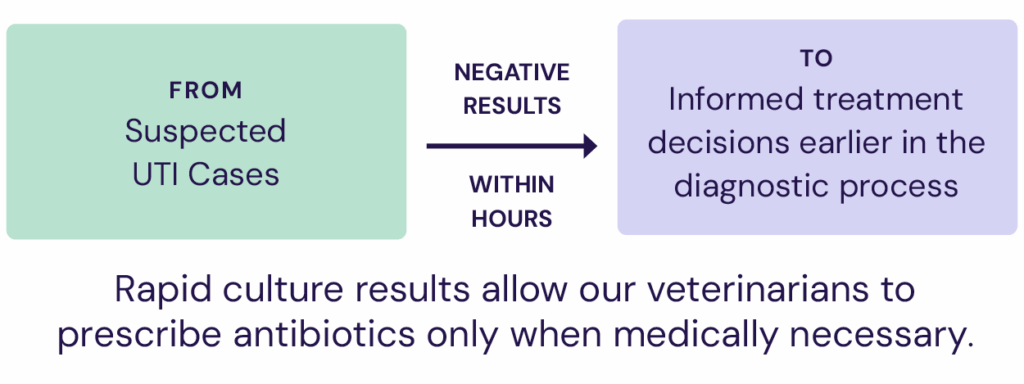
- FIRSTract™ pour des résultats de culture d'urine plus rapides — confirme la présence de bactéries en croissance active en quelques heures
- Identification microbienne rapide utilisant la spectrométrie de masse pour détecter l'empreinte protéique unique de chaque organisme (MALDI-TOF)
- Axé sur les lignes directrices: Clinical and Laboratory Standards Institute (CLSI) pour l'identification précise des micro-organismes et la sensibilité aux antimicrobiens et European Medicines Agency (EMA) catégorisation des antibiotiques pour promouvoir une utilisation responsable des antimicrobiens.
- Consultation d'experts:Accès à des spécialistes en médecine interne et à un microbiologiste vétérinaire certifié.
- Délai d'exécution rapide:Résultats initiaux dans les 24 heures et identification de la culture avec les résultats de sensibilité aux antimicrobiens rapportés dans 2 à 4 jours.

Rencontrez notre microbiologiste
Le Dr Meera Surendran Nair, DVM, MS, MSCTR, Ph.D. DACVM, est directrice du département des maladies infectieuses chez Antech Diagnostics™. Microbiologiste et immunologiste vétérinaire certifiée, elle est passionnée par les innovations diagnostiques et collabore au déploiement de solutions diagnostiques qui permettent de résoudre les mystères des maladies. Elle s'engage en faveur du diagnostic et de la gestion des antimicrobiens.
Ressources
Vos outils de référence pour des tests de microbiologie en toute confiance.
Flyers et téléchargements
- Guide d'hémoculture (États-Unis)
- Guide d'hémoculture (Canada)
- Guide de culture de l'oreille (États-Unis)
- Guide de culture de l'oreille (Canada)
- Détailleur de services de microbiologie
- Guide de prélèvement et de manipulation d'échantillons microbiologiques (par source) (États-Unis)
- Guide de prélèvement et de manipulation d'échantillons microbiologiques (par source) (Canada)
- Guide de culture cutanée (États-Unis)
- Guide de culture cutanée (Canada)
Contact et support
Besoin d'aide pour choisir le bon code de test ou interpréter votre rapport ? Nous sommes là pour vous aider.
- Soutien à la consultation:Parlez à nos experts cliniques. (États-Unis) 800-872-1001, option 2 ; (Canada) 800-341-3440, option 2
- Service client:Pour toute question relative à la logistique, aux commandes et aux soumissions. (États-Unis) 800-872-1002, option 0 ; (Canada) 800-341-3440, option 0
Découvrez des solutions de microbiologie précises, exactes et flexibles pour des soins de qualité supérieure.
Webinaires
Mise à jour concernant les modifications apportées aux points d'arrêt CSLI
Aperçu du MIC
Examen de l'approche d'interprétation d'un profil de culture et de sensibilité
Quoi de neuf chez Antech
-

La santé mentale en médecine vétérinaire, sixième partie : Créer une culture du bien-être et devenir un agent de changement avec le Dr Jen Brandt
Cet extrait provient du dernier épisode d'une série de trois podcasts sur la santé mentale en médecine vétérinaire, « Tails From the Lab », animée par Brad Ryan (MSc, DVM, MPH), vétérinaire responsable des services professionnels chez Antech, en conversation avec Jen Brandt (LISW-S, PhD), directrice des initiatives de bien-être des membres à l'AVMA. Dans cet épisode, les docteurs Brad et Jen abordent l'impact du surmenage…
-
La santé mentale en médecine vétérinaire, cinquième partie : Créer une culture du bien-être avec le Dr Jen Brandt
Cet extrait provient du dernier épisode d'une série de trois podcasts sur la santé mentale en médecine vétérinaire, « Tails From the Lab », animée par Brad Ryan (MSc, DVM, MPH), vétérinaire responsable des services professionnels chez Antech, en conversation avec Jen Brandt (LISW-S, PhD), directrice des initiatives de bien-être des membres à l'AVMA. Dans cet épisode, les docteurs Brad et Jen abordent la question de…
-
La santé mentale en médecine vétérinaire, quatrième partie : L’autocompassion et le perfectionnisme avec le Dr Jen Brandt
Voici le deuxième épisode d'une série en trois parties sur la santé mentale en médecine vétérinaire, extraite du podcast Tails from the Lab, animé par Brad Ryan (MSc, DVM, MPH), vétérinaire responsable des services professionnels chez Antech, en conversation avec Jen Brandt (LISW-S, PhD), directrice des initiatives de bien-être des membres à l'AVMA. Dans cet épisode, les docteurs Brad…